


Donate Here
•
Legal Corner
If you have been the victim of a crime, you may be able to apply for financial assistance through a government-run victim compensation scheme.
These schemes give people compensation in recognition of the harm, hardship and expense experienced by victims of crime.
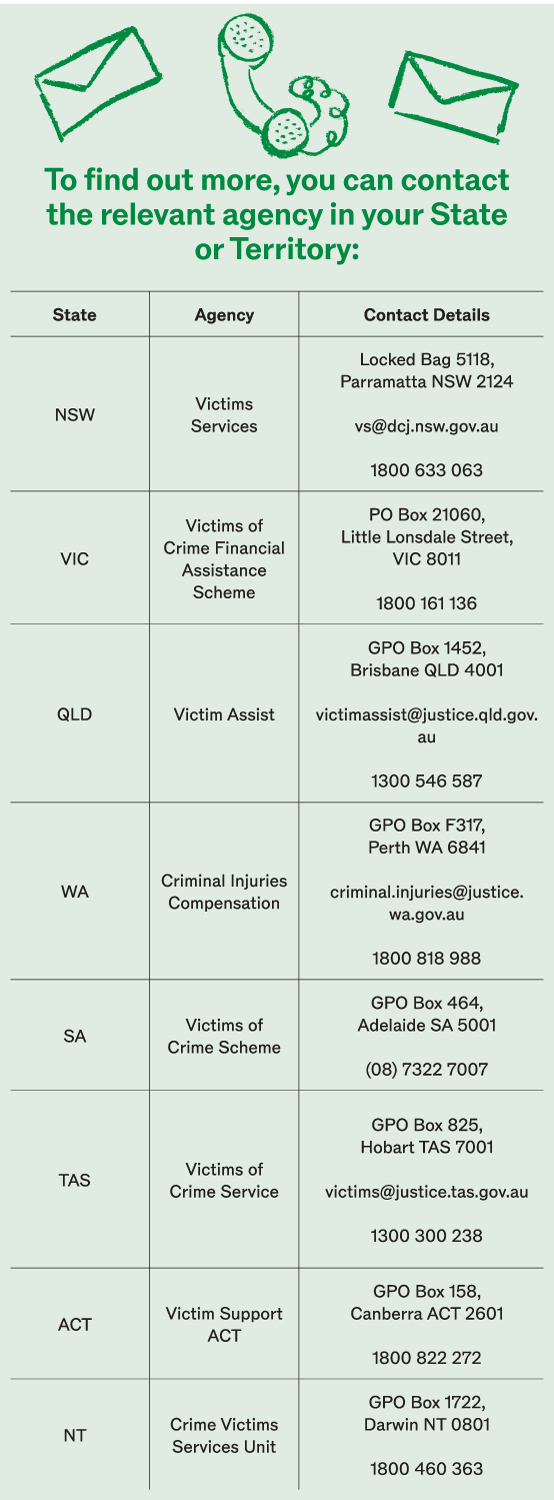
Each state and territory in Australia has its own agency that manages applications for victim compensation.
For example, in Queensland, victims of crime can apply to an agency called Victim Assist.
Victim Assist can provide two types of financial assistance.
It can provide money to recover costs (medical expenses, loss of earnings, etc.), or it can provide a lump sum in recognition of hardship.
You can apply for financial assistance through Victim Assist if you:
- have an injury from an act of violence which occurred in Queensland, and
- have, or someone else has, reported the act of violence.
And you are:
- the victim of an act of violence; or
- the parent of a child who was a victim of an act of violence; or
- a witness to an act of violence; or
- a close family member of a person killed by an act of violence.
You need to apply for financial assistance within three years of the act of violence. If you were under 18 when the violence happened, you have until you are 21 to apply. Extra time can only be given in special circumstances.
In most cases, you need to report the crime to police. There are some exceptions, but you will need to tell Victim Assist the reason you couldn’t report to police.
There are different rules and schemes which apply to people in other states.
Date Published
October 1, 2026
By About Time
By About Time
There are major differences between how offences in prisons are dealt with around Australia. These offences typically range from minor ones, such as keeping an untidy cell, to more serious ones and others that can become criminal charges.
ISSUE NO. 17
•
3 MIN READ
By Human Rights Law Centre
By Human Rights Law Centre
All people behind bars should be treated with dignity.
ISSUE NO. 10
•
6 MIN READ
By Daniel Vansetten
By Daniel Vansetten
This is the first of a two-part series on Freedom of Information (FOI), (also called Right to Information). In this part, we explain why FOI is important and how to lodge an application for information.
ISSUE NO. 4
•
9 MIN READ
By RACS (Refugee Advice and Casework Service)
By RACS (Refugee Advice and Casework Service)
You got this letter to say that your visa has been cancelled due to your offending. This means you no longer hold a visa.
ISSUE NO. 15
•
4 MIN READ
By Anthony Burke
The law, like other professions, has its own language. It helps keep all the lawyers huddled around some special stuff and keep the rest of us outside.
ISSUE NO. 26
•
4 MIN READ
Prisoners’ Legal Service QLD
On 1 April 2026, the Australian Parliament passed new laws which will change the way Commonwealth parole works.
ISSUE NO. 25
•
3 MIN READ
By About Time
People in prison can apply to transfer from a prison in one state or territory to another, generally for welfare reasons to be closer to family, community supports, or rehabilitation opportunities.
ISSUE NO. 24
•
4 MIN READ
By About Time
Inspectors and ombudsmen regularly go to prisons and publish reports on what they find and what they think needs to be improved. They also complete reports on issues such as access to healthcare or the use of segregation.
ISSUE NO. 23
•
4 MIN READ