
As a person who has worked, albeit infrequently, as a journalist since 2019, I can tell you first hand that most published articles come and go with little fanfare. Newspapers in the community are read one day and then in the bin the next. Online articles get their day in the limelight on a home page and then fade into the background with the others.
But occasionally an article can help make real changes for the lives of thousands of people and their families. In October 2024, Kelly Flanagan, then incarcerated at Dame Phyllis Frost Centre, wrote an article for About Time on the exorbitant price of prison phone calls in Victoria. As Kelly’s article highlighted, she was paid $1.56 an hour as a sewing machinist. However, a 12-minute phone call in Victorian prisons cost $6.84. If she made two calls a week, this would not allow her to buy items like stamps and toiletries, which were not provided.
Kelly’s personal story of how this impacted her ability to stay in touch with family struck a chord in a way that cold facts alone cannot. Her article was picked up by mainstream media, including 7News. “Prison newspaper About Time shedding light on mental health toll of costly prison phone calls”, read the title of their article from later that month. The story also made waves on social media.
It must be noted that many people and organisations have been lobbying for cheaper or even free prison phone calls in Victoria and elsewhere for years. Only a few months earlier, SBS News reported that 13 organisations had pushed for free calls in Victoria, stating that people in custody should not be forced to choose between calling their family and purchasing basic items. The article brought much-needed attention to an important issue, but it lacked insight from anyone currently impacted. This is not too surprising since journalists cannot legally interview people incarcerated in Victoria. However, lived experience of incarceration brings a deeper understanding of prison issues that simply cannot be replicated.
It’s impossible to know exactly how much impact Kelly’s article had on the subsequent reduction of call costs. However, after many years of things remaining the same, changes were finally implemented only a few months later. At the beginning of February 2025, the maximum price of a phone call in Victoria was reduced to $3 – still more expensive than some jurisdictions in Australia, although undeniably a step in the right direction.
Since then there’s been many changes to prison phone call costs around Australia. Corrections in all jurisdictions were contacted and provided prices, except Queensland, although costs were only obtained in South Australia following a freedom of information request. A media request to Queensland Corrective Services for prices was denied, and they also delayed a subsequent right to information request for the data “due to the number of applications received and the subsequent workload on [their] business unit”. Costs in Queensland were accordingly provided by released prisoners. Call durations are mostly capped at 10 minutes around the country, although they are 12 minutes in Victoria, and are reported to be 8 minutes for some prisoners in Queensland.
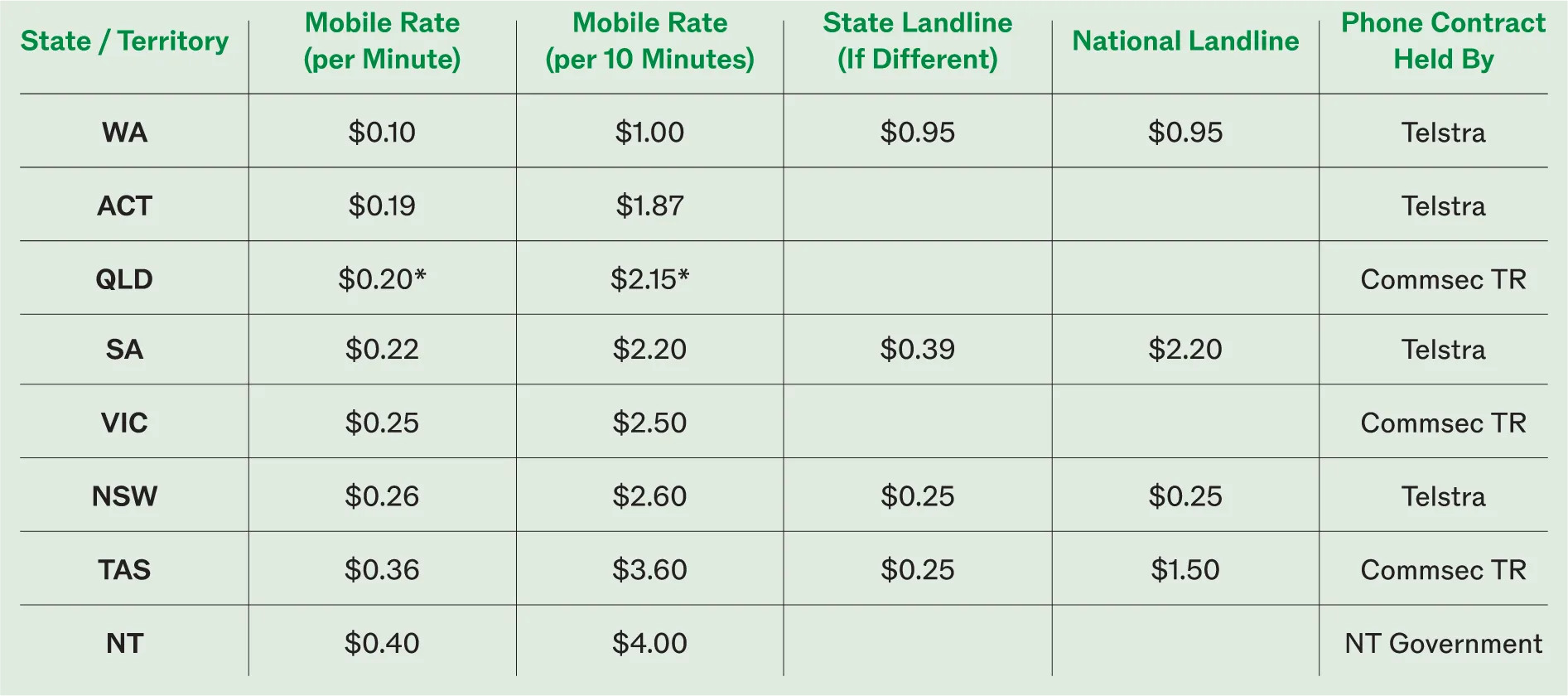
Since Kelly’s article was printed, prison phone costs have also been reduced in South Australia. The ACT and Queensland have also significantly reduced the costs of calls to mobiles. However, in both jurisdictions the cheaper rate for landline calls, which was around 30 or 40 cents, has been removed. Landline calls now face the same rate as mobiles. This has significantly increased costs for numerous people to stay in contact with their families, many of whom had purchased landline phones specifically to allow for affordable contact.
Conversely, while the rate for mobiles remains largely unchanged in NSW, the cost of all landline calls has been reduced significantly to only 25 cents. Sentenced prisoners in NSW now also get one free landline and one free mobile call per week, and remand prisoners receive three landline calls and one mobile. Rates apply once free calls are used. However, prices will still be higher for many people than they were before June 2023, when Corrections in NSW removed the ability to access third-party services that reduced call costs.
Prices in the Northern Territory and Tasmania, which now have the highest and second highest costs for calls to mobiles respectively, remain unchanged, as do those in Western Australia, which has long had the cheapest mobile calls in Australia.
While for the most part calls to mobiles are becoming cheaper, we clearly still have a long way to go. The removal of discounted landline calls, as well as third-party services, is also particularly concerning. There’s no denying that contact with family is a proven way of reducing reoffending and improving mental health. Recognising this, prison phone calls have been made free in at least four states in the US.
A campaign is currently underway to try and make phone calls free in NSW. People outside prison can learn more by visiting:
Since then there’s been many changes to prison phone call costs around Australia. Corrections in all jurisdictions were contacted and provided prices, except Queensland, although costs were only obtained in South Australia following a freedom of information request. A media request to Queensland Corrective Services for prices was denied, and they also delayed a subsequent right to information request for the data “due to the number of applications received and the subsequent workload on [their] business unit”. Costs in Queensland were accordingly provided by released prisoners. Call durations are mostly capped at 10 minutes around the country, although they are 12 minutes in Victoria, and are reported to be 8 minutes for some prisoners in Queensland.
Since Kelly’s article was printed, prison phone costs have also been reduced in South Australia. The ACT and Queensland have also significantly reduced the costs of calls to mobiles. However, in both jurisdictions the cheaper rate for landline calls, which was around 30 or 40 cents, has been removed. Landline calls now face the same rate as mobiles. This has significantly increased costs for numerous people to stay in contact with their families, many of whom had purchased landline phones specifically to allow for affordable contact.
Conversely, while the rate for mobiles remains largely unchanged in NSW, the cost of all landline calls has been reduced significantly to only 25 cents. Sentenced prisoners in NSW now also get one free landline and one free mobile call per week, and remand prisoners receive three landline calls and one mobile. Rates apply once free calls are used. However, prices will still be higher for many people than they were before June 2023, when Corrections in NSW removed the ability to access third-party services that reduced call costs.
Prices in the Northern Territory and Tasmania, which now have the highest and second highest costs for calls to mobiles respectively, remain unchanged, as do those in Western Australia, which has long had the cheapest mobile calls in Australia.
While for the most part calls to mobiles are becoming cheaper, we clearly still have a long way to go. The removal of discounted landline calls, as well as third-party services, is also particularly concerning. There’s no denying that contact with family is a proven way of reducing reoffending and improving mental health. Recognising this, prison phone calls have been made free in at least four states in the US.
A campaign is currently underway to try and make phone calls free in NSW. People outside prison can learn more by visiting:


