


Donate Here
•
Experiences
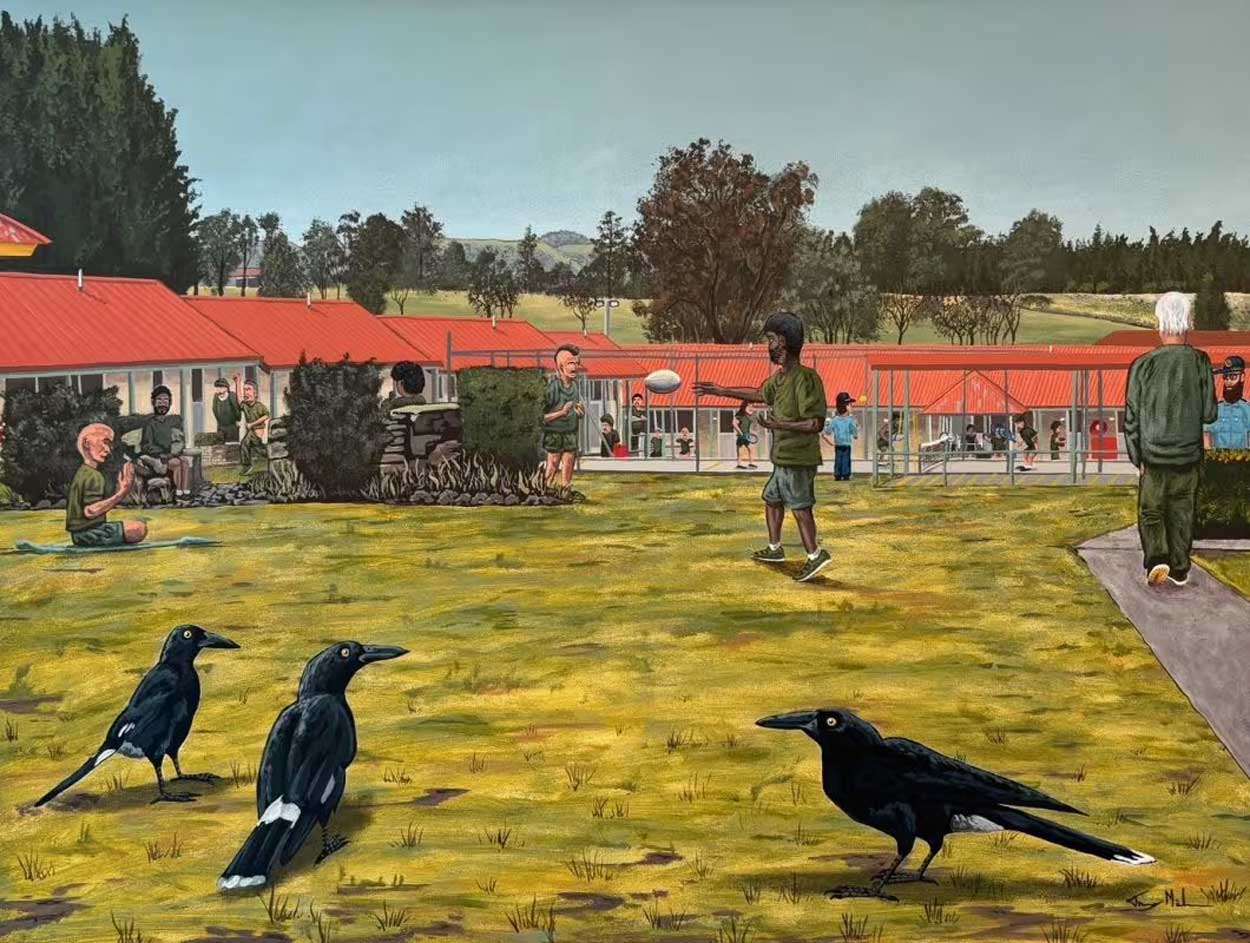
“Glen Innes Compound” by Tony, available to purchase from Boom Gate Gallery
The entertainment and news media loves to show a confrontational and violent “don't back down” version of prison life, but what they don't show is the genuine care and openness between strangers in prison. People ask strangers in the cells if they are okay, just because they look like they're not. They share stories and feel each other's pain and frustration, crack jokes and laugh it up, just to make it a little more bearable.
This is happening all the time, every day – violence and conflict is the rare exception to this – although the threat of violence is real and its shadow lingers over everything.
I don't like violence one bit. Of course I would defend myself if it came to that, but I’ll do everything I can to avoid violent conflict. I didn't grow up with high levels of violence like most people in prison did. When I was first in prison in my early 20s, I got the feeling that everyone could see I hadn't suffered through a childhood and life of violence like they had. It took me a while to understand that threats against me were more an attempt to intimidate than a statement of intention and that rattling me was for some both entertaining and made them feel stronger – it was the armour they wore for their scars.
I went to prison many times for my peaceful protests against what I saw as the violence of our global political order, which, along with my veganism at the time, automatically made me stand out as a “hippy” in prison.
While some other prisoners thought I was mentally ill for taking a stance that led me to jail repeatedly for no clear personal gain (or just wanted to joke that I was going to get sent upstairs to the psych wing), I found most people understood my grievances with the world, immediately and instinctively, much more so than the privileged, educated people I met at university.
Prisoners know from their experience of dehumanisation (being treated like you are not a human who matters or deserves any kind of respect) that this system is stacked against the people who find themselves on the bottom.
They know the systemic injustices of the world because they’ve lived them firsthand. The “crime problem” is really an injustice problem. Crime in society will only decrease as justice increases.
In some prisons, prisoners are pitted against each other, as if it's part of the punishment. Very little is done to stop a culture of violence and intimidation in prison – the cycle of violence and ongoing trauma is then used to justify the continuous scapegoating and incarceration of the criminal class.
If “rehabilitation” or processing your own trauma and healing your spirit is possible in prison, it is a personal choice.
I remember a guy a bit older than me opening up to me at Port Phillip Prison and telling me, “It’s easy when you don't care – you can do whatever and you don't give a fuck – but when you care it's real hard.”
He was making the hard choice because he wanted to care, wanted to be accountable for himself and his actions, and not just spread his pain around in a society that most of the time doesn’t seem to care. I really respected that.
Prisoners of like mind can find each other, show each other care and camaraderie, help each other understand their wounds and get out of the cycle of reacting to the bullshit life has served them in a way that further harms them.
There are examples of prisoners starting and running groups all around the world, groups that talk about the traps of hyper-masculinity and how to be strong by encouraging the strength in others. They are hugely successful, and any of you can start one.
Prisoners have many of the same struggles in common. If we recognise this and work with each other, the positive impact goes far beyond the personal.
Prisoners know something from experience, something that cannot be taught: how it feels and how wrong it is to dehumanise anyone.
A person who processes their trauma is a fighter for real justice, and the best fighters for real justice come from the bottom.
Hold your head up high, be accountable, and the world is yours. Getting stuck reacting to unexamined pain and clinging on to excuses is a recipe for misery. To me, the most vital part of masculinity is to love your brothers and sisters, fight for justice and protect country. I don't care what slur anyone would use against me for saying this: I love you brothers, I feel your pain, and I genuinely want the best for you and hope you do too. You deserve it after all you have been through.
They know the systemic injustices of the world because they’ve lived them firsthand. The “crime problem” is really an injustice problem. Crime in society will only decrease as justice increases.
In some prisons, prisoners are pitted against each other, as if it's part of the punishment. Very little is done to stop a culture of violence and intimidation in prison – the cycle of violence and ongoing trauma is then used to justify the continuous scapegoating and incarceration of the criminal class.
If “rehabilitation” or processing your own trauma and healing your spirit is possible in prison, it is a personal choice.
I remember a guy a bit older than me opening up to me at Port Phillip Prison and telling me, “It’s easy when you don't care – you can do whatever and you don't give a fuck – but when you care it's real hard.”
He was making the hard choice because he wanted to care, wanted to be accountable for himself and his actions, and not just spread his pain around in a society that most of the time doesn’t seem to care. I really respected that.
Prisoners of like mind can find each other, show each other care and camaraderie, help each other understand their wounds and get out of the cycle of reacting to the bullshit life has served them in a way that further harms them.
There are examples of prisoners starting and running groups all around the world, groups that talk about the traps of hyper-masculinity and how to be strong by encouraging the strength in others. They are hugely successful, and any of you can start one.
Prisoners have many of the same struggles in common. If we recognise this and work with each other, the positive impact goes far beyond the personal.
Prisoners know something from experience, something that cannot be taught: how it feels and how wrong it is to dehumanise anyone.
A person who processes their trauma is a fighter for real justice, and the best fighters for real justice come from the bottom.
Hold your head up high, be accountable, and the world is yours. Getting stuck reacting to unexamined pain and clinging on to excuses is a recipe for misery. To me, the most vital part of masculinity is to love your brothers and sisters, fight for justice and protect country. I don't care what slur anyone would use against me for saying this: I love you brothers, I feel your pain, and I genuinely want the best for you and hope you do too. You deserve it after all you have been through.
Date Published
November 6, 2025
By David
My name is David. I am a proud Yorta Yorta man currently locked up in Victoria.
ISSUE NO. 26
•
3 MIN READ
By Ivan
It was mid-afternoon in the Port Campbell area, with a southerly wind blowing, and Henry and I were just about to leave the Boggy Creek Café.
ISSUE NO. 26
•
3 MIN READ
By Gary Griffiths
Father’s Day can bring pride, guilt, sadness, hope, or all of them at once, and being in jail doesn’t stop that.
ISSUE NO. 26
•
2 MIN READ
By Kelly Flanagan
Being kind is something I find really challenging at times.
ISSUE NO. 25
•
2 MIN READ