


Donate Here
•
Experiences
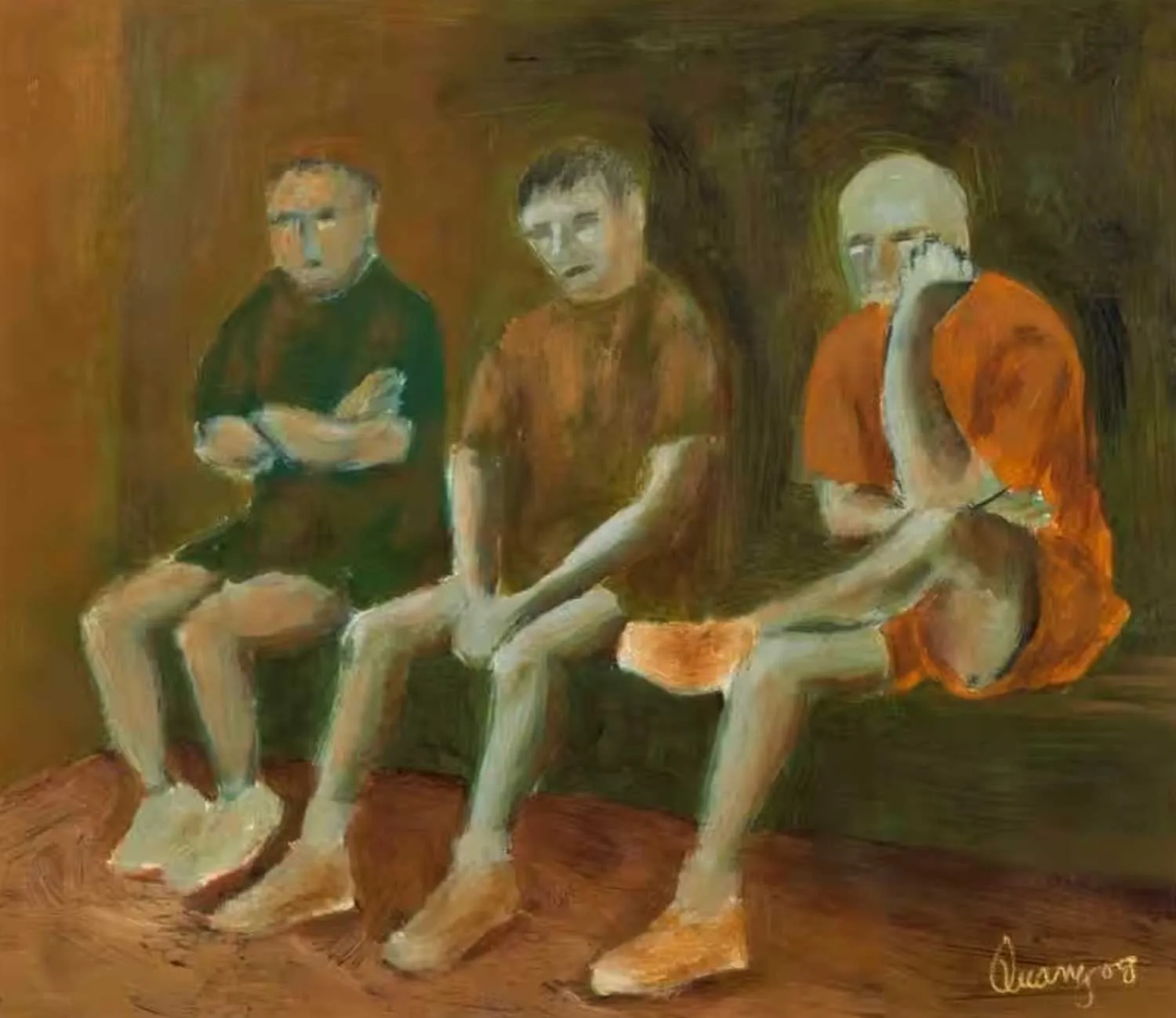
‘Holding Cell 1’ by Quang Nguyen, Collection CSNSW
As we get back into our cells from muster, preparing to be locked-in until tomorrow morning, one of the non-descript guards tosses a few stale sausage rolls onto the concrete slab of our floor, then slams the door shut to lock us in. I give my two rolls to Nick. After only a few minutes, and as if to spare Nick the indignity of eating this stuff, Nick gets called to go to the visiting area. Because I’m a green card (and not a real person at all), the two guards take me to an adjacent cell where I’m told I will stay until Nick’s return. I’m going to stay in Jonny’s cell with Jonny and his cellie.
The thought of spending any time in close contact with Jonny sets my heart racing – and not in a good way. Surges of adrenalin flood throughout my body and brain. I know who Jonny is. He’s that young guy who strides so proudly in the yard with his “bruvvas” as they parade back and forth.
They all look menacingly the same. They also look rather robotic, and yet like feral animals, and they march in packs of five to six at a time.
I’ve watched Jonny and his mates closely from the sidelines as they parade their young muscular bronzed bodies for all to see and fear. Tanned, oiled and almost hairless, their beautiful tattooed bodies gleam gold in the sunshine like some ancient Greek or Egyptian mini-gods.
Not knowing how long I will be spending my time with Jonny, I take with me the only book that I can find in my cell. Ironically, I have only recently begun to read a tattered copy of Albert Camus’ book, The Plague. A literary classic, the book is all about how the people of Oran experienced and dealt with the bubonic plague during the 1940s. As I prepare to enter Jonny’s cell, I’m not sure which might be worse, reading about suffering and death from the bubonic plague, or spending a few hours with Jonny and whoever is his cellie.
The guard delivers me to Jonny’s cell, ushers me in and, just as efficiently, slams and locks the heavy blue door. The two young guys don’t pay any attention to me at first. While Jonny seems intent on yelling incoherently out the window to his fellow “bruvvas”, his cellie reclines inertly on his bed. Having no idea how I’ll be received, I feel nervous being confined with Jonny, and so I spend the first 15 minutes perched awkwardly on a low stool trying to concentrate on reading. But it’s of little use and shortly after Jonny signs off with several expletive-filled farewells to his “bruvvas”, we engage in a few friendly ice breaking comments.
Jonny then begins to talk, not in irrelevancies, but about the things that are important to him – the conditions in jail, stories of his past crimes, his regret and how he’s failed most of his family members. As I listen, I sense that Jonny needs to talk, and I remain fixed like glue to what Jonny has to say. Periodically, as we sit eye-to-eye, I nod in agreement, or frown, or shake my head in silent awe in response to what I am hearing. Mostly, I remain silent yet careful to be fully present and attentive. After quite a long time, to my utter surprise, Jonny offers to make me a cup of coffee, then he offers two of his prized chocolate-mint slice biscuits. He also checks that I’m physically comfortable and not cold. It suddenly dawns upon me that Jonny, the young fearless warrior, is actually taking care of me. Some sort of bonding has taken place. I’m now feeling quite conflicted about my pre-conceived, and incorrect, ideas of Jonny. I’m even a little overwhelmed that someone so seemingly “aggro” and combative can care about some stranger who is totally different from himself.
Sharing our belongings in prison is not an uncommon practice, even in the midst of a good deal of thieving of buy-up items by some inmates. Most inmates understand that very few of us want to be behind bars. We are mostly all in the same boat. Even amongst the most notorious of inmates, there exist fragments of buried compassion. There is an element of “good” in everyone, or so the saying goes. None of us has much in the way of belongings, but when times get rough, the stray gift of a Mintie, a small chocolate bar, or some other small mercy, can be sufficient to alleviate the bitterness of our situation, at least for a while.
When Nick returns, I am transferred back to my cell with him. Jonny treats me with sincerity as I leave, and he wishes me well.
Many inmates, I later discover, are vastly different in a one-on-one conversation, compared to their persona when they are with their mates in the yard. What an afternoon! What a lesson for me!
I never saw Jonny again. A day or two later, many of the guys in the yard were talking about how Jonny had been “busted” with drugs in his cell, had become violent, and was in segro, due to be relocated to “super max” at Goulburn. My heart sank.
I’m sure that Jonny didn’t see me as a rival in any way. Whatever bond we developed was based on my preparedness to listen to him, to hear and acknowledge what he had to say about a range of issues. I may be one of only a few inmates who took him seriously and offered genuine concern. In return, he was prepared to trust
me with his stories, and his chocolate biscuits.
Sharing our belongings in prison is not an uncommon practice, even in the midst of a good deal of thieving of buy-up items by some inmates. Most inmates understand that very few of us want to be behind bars. We are mostly all in the same boat. Even amongst the most notorious of inmates, there exist fragments of buried compassion. There is an element of “good” in everyone, or so the saying goes. None of us has much in the way of belongings, but when times get rough, the stray gift of a Mintie, a small chocolate bar, or some other small mercy, can be sufficient to alleviate the bitterness of our situation, at least for a while.
When Nick returns, I am transferred back to my cell with him. Jonny treats me with sincerity as I leave, and he wishes me well.
Many inmates, I later discover, are vastly different in a one-on-one conversation, compared to their persona when they are with their mates in the yard. What an afternoon! What a lesson for me!
I never saw Jonny again. A day or two later, many of the guys in the yard were talking about how Jonny had been “busted” with drugs in his cell, had become violent, and was in segro, due to be relocated to “super max” at Goulburn. My heart sank.
I’m sure that Jonny didn’t see me as a rival in any way. Whatever bond we developed was based on my preparedness to listen to him, to hear and acknowledge what he had to say about a range of issues. I may be one of only a few inmates who took him seriously and offered genuine concern. In return, he was prepared to trust
me with his stories, and his chocolate biscuits.
Date Published
April 5, 2025
By MJ
When I get released at the end of this year, I am faced with a massive uphill climb with barely a rope to save me.
ISSUE NO. 27
•
2 MIN READ
By Jonathan
When I was first transferred to PPP in 2000, I was warned about the dentist colloquially known as ‘The Butcher.’ I attended the dentist for a sore molar.
ISSUE NO. 27
•
3 MIN READ
By Andrew
I finally finished my VPP (Violence Prevention Program) in late June. It was one of the wisest decisions I ever made.
ISSUE NO. 27
•
3 MIN READ
By David
My name is David. I am a proud Yorta Yorta man currently locked up in Victoria.
ISSUE NO. 26
•
3 MIN READ