


Donate Here
•
Experiences
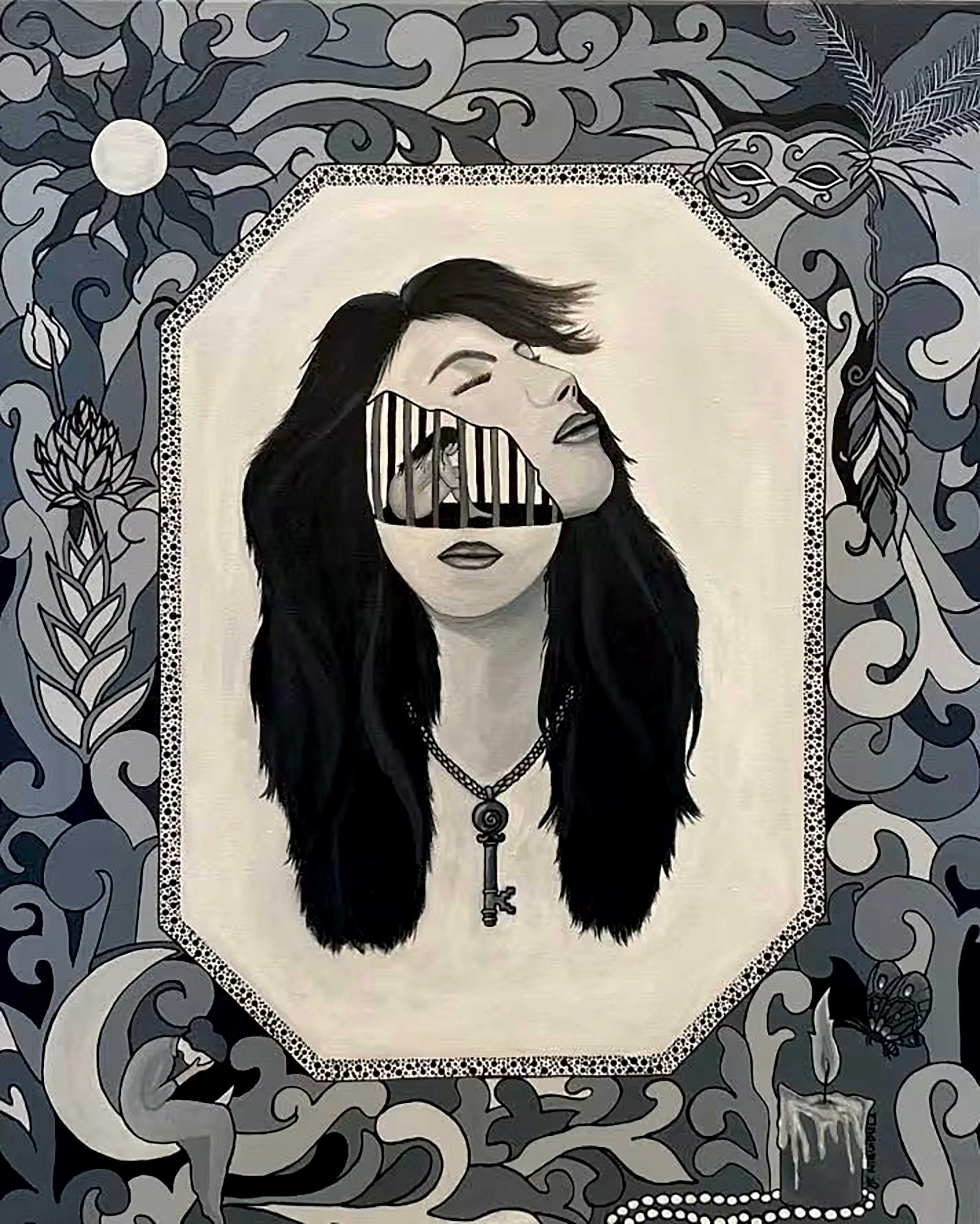
'Frame with a Frame' by Jenny, $500, 5501, 75cm x 60cm, acrylic on canvas, available to purchase from Boom Gate Gallery
I am a prisoner at Dame Phyllis Frost Centre and have been since February 2022. I have no family in Melbourne that can visit me in person. Nor do they drop off property or top up my account with money. I solely rely on my wages from working a full-time job inside the prison. My job title is a Sewing Machinist. This job requires me to sew prison-issue women’s blue tracksuit pants, and jumpers together from pieces to a completed product in the prison industry's portable building inside DPFC prison. My position consists of working 6 hours per day, Monday to Friday, 30 hours per week at $1.56 per hour worked.
From the calculations below, you can have some idea of the money I make weekly from my full-time job here at DPFC.
Weekly money:
$1.56 per hour worked x 6 hours of work per day = $9.36
$9.36 per day wages x 5 days worked in a week = $46.80
$46.80 per week wages – 20% that goes into a compulsory savings account for release date = $37.44
$37.44 per week available to spend on toiletries, phone credit, stationary. stamps, printing and special spend items such as shoes, radios, card games and paint by numbers.
I rely on phone calls and Zooms to contact my family. I come from a low socioeconomic background and my Mother cannot read or write. My Father is very limited in both areas as well. I cannot Zoom my Mum when my Dad is away working as she cannot navigate a mobile phone. My daughter is 19 years old now. She was 17 when I was arrested and sent to prison.
So let’s start with Zoom. In DPFC we only get two Zooms per week. They are not unlimited. There is a one-hour time limit on all personal Zooms. Personal Zooms must be booked 72 hours in advance by the prisoner. However, if you have two Zoom calls in one week, you are not permitted to have a visit in person. If you have one Zoom, then you are permitted to have one visit in person for up to two hours. Legal visits are unlimited in person and on Videolink but must be booked 72 hours in advance via the prison’s Telecourt team.
Now let’s move on to the mail system. DPFC has now put a policy in place that sends back pen pal mail, as mail from strangers is not accepted. Mail from other jails across Australia is being refused and sent back if DPFC believes the sender appears to not know the addressee personally. This has caused confusion for all. There has been frustration from women and a decline in mental health, as some women have had their family or partner’s mail returned to them stating, “mail from strangers will not be accepted.” DPFC is the only jail in the country to implement this policy to date.
The prisoner telephone system (PTS) and phone call costs inside prisons in Australia have been a topic of conversation for many years. Today it is still an ongoing issue. I have been doing some research on the call costs in each state and territory in Australia and have come across some very interesting facts. All states and territories charge prisoners different rates to call home numbers and mobile phones, even if the service provider is the same. All calls are done via a VoIP (Voice over Internet Protocol) service, which means that there is no actual phone line required. The internet hosts the call and records the file for later use, if and when the recording is needed.
Comsec TR (Telio) is a European prison media and communications provider. Comsec TR is charging these kinds of rates to provide a secure phone system and we all understand the importance of security in a prison setting. Comsec TR says they charge these rates due to the highest levels of security measures it takes to monitor and record these calls.
However, if it provides the same service to each state (which by the way, it is), why such differences in the prices?
We also talk about reducing recidivism. To do that people need to heal and that includes healing broken relationships in prison.
Most women that I talk with make those hard reconnection calls to people they have hurt while in prison. Prisons and the government should encourage nurturing and maintaining those connections. Phone calls are vital to stay together and continue building and repairing relationships to reduce recidivism.
Humans want to be accepted, loved, and feel needed and appreciated. It has been proven time and time again that it is possible to stop women from reoffending. This can be done by prisoners repairing those connections with family and children. It gives a fighting chance and a purpose to change. You want to really help us? Then start listening to us.
I am a female prisoner. I want to call my beautiful daughter every day and tell her I miss her face and I love her to the moon and back. I want to laugh with her, cry with her, and just listen to her thoughts, complaints, and boyfriend problems. I can only make one call per week.
I also have to call my elderly mother once a week and check up on her and tell her that I miss her and can’t wait to cuddle her. My daughter and my mum both only have mobile numbers.
I only make $9.36 a day. If I make two calls a week, I don’t have enough money left over to buy toiletries and stamps.
I have lost everything coming to prison. I don’t want to lose my daughter and mum too. I deserve love, acceptance, family support, and the right to communicate with my family who are fighting to help me succeed in moving forward away from drugs and crime. I shouldn’t be stopped from seeking their love and help because I don’t have money to pay exuberant call costs.
I’m hoping that the people who read this feel the pain and my desperate call for help. I am pleading with the local, state, and federal governments. Stop penalising and punishing us for being poor. Stop allowing companies to make millions from the most disadvantaged population in our society. Help us heal and rebuild our broken connections to family. They are already in pain from losing us. Don’t let them suffer more.
Let’s make a change. You be the person to help change it. It just takes a compassionate, understanding, and brave person to help fight with us and for us. We are not monsters. Some of us are here for finally standing up to our abuser. Some of us are here for traffic accidents gone wrong. Some women are here cause they couldn’t afford groceries for their kids and stole. Some women are here as they have been taken advantage of. Sexually abused, drugged, and made to work as sex workers under horrible people who use women as a commodity to be sold and traded, nothing more. Some women are here for simply being in love with the wrong man and now are considered to be their co-offender. There are lots of reasons why we are here.
We are still women, mothers, daughters, aunties, and sisters.
We all deserve to be loved, and respected and have unlimited contact with our family and children. Phone calls should not be used as a means to make money from us. Our families are suffering. Our children are missing us and need us more than ever. Especially if we cannot be there in person to help guide them.
Humans want to be accepted, loved, and feel needed and appreciated. It has been proven time and time again that it is possible to stop women from reoffending. This can be done by prisoners repairing those connections with family and children. It gives a fighting chance and a purpose to change. You want to really help us? Then start listening to us.
I am a female prisoner. I want to call my beautiful daughter every day and tell her I miss her face and I love her to the moon and back. I want to laugh with her, cry with her, and just listen to her thoughts, complaints, and boyfriend problems. I can only make one call per week.
I also have to call my elderly mother once a week and check up on her and tell her that I miss her and can’t wait to cuddle her. My daughter and my mum both only have mobile numbers.
I only make $9.36 a day. If I make two calls a week, I don’t have enough money left over to buy toiletries and stamps.
I have lost everything coming to prison. I don’t want to lose my daughter and mum too. I deserve love, acceptance, family support, and the right to communicate with my family who are fighting to help me succeed in moving forward away from drugs and crime. I shouldn’t be stopped from seeking their love and help because I don’t have money to pay exuberant call costs.
I’m hoping that the people who read this feel the pain and my desperate call for help. I am pleading with the local, state, and federal governments. Stop penalising and punishing us for being poor. Stop allowing companies to make millions from the most disadvantaged population in our society. Help us heal and rebuild our broken connections to family. They are already in pain from losing us. Don’t let them suffer more.
Let’s make a change. You be the person to help change it. It just takes a compassionate, understanding, and brave person to help fight with us and for us. We are not monsters. Some of us are here for finally standing up to our abuser. Some of us are here for traffic accidents gone wrong. Some women are here cause they couldn’t afford groceries for their kids and stole. Some women are here as they have been taken advantage of. Sexually abused, drugged, and made to work as sex workers under horrible people who use women as a commodity to be sold and traded, nothing more. Some women are here for simply being in love with the wrong man and now are considered to be their co-offender. There are lots of reasons why we are here.
We are still women, mothers, daughters, aunties, and sisters.
We all deserve to be loved, and respected and have unlimited contact with our family and children. Phone calls should not be used as a means to make money from us. Our families are suffering. Our children are missing us and need us more than ever. Especially if we cannot be there in person to help guide them.
Date Published
July 31, 2026
By MJ
When I get released at the end of this year, I am faced with a massive uphill climb with barely a rope to save me.
ISSUE NO. 27
•
2 MIN READ
By Jonathan
When I was first transferred to PPP in 2000, I was warned about the dentist colloquially known as ‘The Butcher.’ I attended the dentist for a sore molar.
ISSUE NO. 27
•
3 MIN READ
By Andrew
I finally finished my VPP (Violence Prevention Program) in late June. It was one of the wisest decisions I ever made.
ISSUE NO. 27
•
3 MIN READ
By David
My name is David. I am a proud Yorta Yorta man currently locked up in Victoria.
ISSUE NO. 26
•
3 MIN READ